What Is a Curl Defining Brush?
What the tool actually does, how it creates definition, and how to use one on 4A through 4C hair.
A curl defining brush gathers your strands into clumps so your natural curl pattern shows up instead of frizzing apart. It is not a detangler and it is not a paddle brush. It is the tool that turns a wash-n-go from fluffy to defined.
A detangling brush separates strands. A defining brush groups them. Two opposite jobs, and using the wrong one is the most common reason a wash-n-go dries undefined.
Why your wash-n-go dries fluffy instead of defined
Here is the thing most people run into. You do your wash-n-go, you use the right products, and your hair still dries fluffy instead of defined. That is usually not a product problem. It is a distribution problem.
Your curls want to clump. Left alone, strands find each other and form a coil. But if you rake product through with your fingers, or comb it out, you break those clumps apart, and what dries is frizz where a curl should have been.
A defining brush does the opposite. The bristles gather strands as they pass through, so instead of separating your hair, the brush is grouping it. That is the whole idea, and it is why the tool exists as its own category.
Defining brush vs. detangling brush vs. denman style
These three get used interchangeably and they do different things. Picking the wrong one is what sends people back to fingers and gel.
| Tool | What the bristles do | Use it for | Result on type 4 |
|---|---|---|---|
| Defining brush | Closely set rows gather strands together | Wet styling, wash-n-go definition | Uniform, springy coils |
| Detangling brush | Widely set rows separate strands apart | Removing knots, pre-wash prep | Smooth but undefined |
| Denman style | Rows clump, spacing built for looser curls | Wet styling on 2 and 3 patterns | Can be too sparse on dense hair |
| Paddle brush | Flat, wide, separates everything | Straight or blown-out hair | Frizz |
Read it by what the bristles do, not by the name on the packaging. Wide and rigid separates. Closely set and flexible gathers. A brush sold as a detangler can still define if its rows are close enough, and a brush sold for definition can be too sparse to do it on dense hair.
How bristle layout creates definition
Three things decide whether a brush clumps or separates.
Row spacing
Rows set close together catch strands and hold them next to each other long enough to form a clump. Rows set wide apart let strands slip between them and land separately. This is the single biggest factor, and it is why a wide tooth comb never produces definition no matter how much product you use.
Bristle flex
Bristles need to give. A rigid bristle forces its way through a tangle and snaps the hair. A flexible bristle bends around the tangle and carries the strand with it. Flex is also what lets one pass do the work, which matters because the second pass through a section is what undoes the clump you just made.
Bristle length against your density
Short bristles ride on top of dense hair and only define the surface. On thick 4B or 4C hair the bristle has to reach the scalp or you get a defined outer layer sitting on an undefined middle. That is what causes a wash-n-go that looks good on day one and collapses on day two.
1. Start soaking wet
Not damp. Not towel dried. Wet. The second your hair starts drying, the clump stops forming. If a section starts to dry while you are working, wet it again rather than pushing through.
2. Put your product on first
Leave-in, then your gel or cream. The brush distributes what is already there. It does very little on dry, bare hair.
3. Work in small sections
Smaller than feels reasonable. On dense 4C hair, four sections is not enough. Eight to twelve gives you control, and the sectioning is half the result.
4. Brush in the direction the curl already wants to go
Usually down and slightly toward your face. You are following the pattern, not creating one.
5. Go through each section once, maybe twice
Then stop. Going back over a section you already brushed is what undoes the clump.
6. Do not touch it while it dries
This is the hard part. Hands off until it is fully dry, then break the cast if you used gel.
Most curl definition advice is written for looser patterns and it falls apart on type 4. A few things change.
Stretch first if your shrinkage is heavy. On tightly coiled hair, brushing into full shrinkage can fight you. A light band-and-dry or a gentle blow-out on cool before you define gives the brush something to work with.
Use more product than you think. Type 4 strands drink it up, and a section that is not slick when you start brushing will not clump. If in doubt, add more.
Expect your definition to look different, not worse. A defined 4C wash-n-go does not look like a defined 3B one, and it should not. You are going for uniform, springy coils, not an S-wave.
Go slow through the crown. It is usually the densest and the driest area, and it is where most breakage happens when people rush.
Re-wet as you go. On 4C, by the time you reach section ten, section one has started drying. A spray bottle beside you is not optional.
- Closely set rows. If you can see daylight easily between the rows, it will separate rather than clump.
- Bristles that flex under light pressure. Press the brush against your palm. If nothing gives, it will pull.
- Bristle length matched to your density. Thick hair needs longer bristles that reach past the outer layer.
- A handle you can hold with wet, conditioner-covered hands. This sounds trivial until you are mid wash day and the brush is sliding out of your grip.
- A shape that moves through dense hair without dragging. A narrower head turns more easily through a small section than a wide paddle does.
- A size that fits the smallest area you style. Edges, the nape and around a part need a smaller tool than the body of your hair.
What does not matter as much as people think: colour, branding, and whether it is marketed for curls or for detangling. Judge it by the bristles.
Most of what people call a product problem on day two is a night problem. Definition rarely fails during the day. It fails while you sleep, and it fails again when you try to fix it.
At night
- Pineapple it loosely at the very top of your head with a satin scrunchie, or twist it into four to six large sections. Either protects the clump. A tight band flattens it.
- Satin bonnet or a satin pillowcase. Cotton pulls moisture out of the clump and roughs up the cuticle, which is what you see as frizz in the morning.
- Never sleep on wet or damp hair. It will dry in whatever shape it was pressed into.
In the morning
- Mist lightly with water, not soaking. You are rehydrating the cast, not restarting the style.
- Smooth a small amount of leave-in over the surface with flat palms. Do not rake and do not re-brush.
- Fluff at the roots with your fingertips only, scalp level, not through the lengths.
The mistake worth naming. Reaching for the defining brush on day two undoes the clump you made on day one and there is not enough water in the hair to form a new one. If a section has genuinely lost its pattern, wet that section properly, add product, and brush just that one. Working dry hair with a defining brush is what turns a two day wash-n-go into a one day one.
Realistically, a well-defined wash-n-go on type 4 hair holds three to five days with this routine. Past that, the buildup starts to matter more than the technique and it is time to wash.
A defining brush collects product. Gel and cream build up between the rows, and a brush with buildup in it stops gathering cleanly and starts dragging.
- Rinse it under warm water after every wash day, before the product dries in it.
- Once a month, work a drop of shampoo through the rows with your fingers and rinse until the water runs clear.
- Dry it bristles down so water does not sit in the base.
- Replace it when bristles stay bent or start splaying outward. A splayed brush separates instead of clumping, which is the whole problem you bought it to solve.
Shop T+P Brushes
The True + Pure Texture Defining & Detangling Brush does both jobs, which is the point. You are not swapping tools mid wash day. The non-slip grip matters more than it sounds when your hands are covered in conditioner, and the shape is built to move through dense, textured hair without dragging. For a smaller area, edges, the nape, around a part, the Precision Mini Detangler is the one that fits where the full-size brush does not.
[ Featured collection section renders below this block in the theme template. Do not hardcode product cards here. ]
What is a curl defining brush?
A curl defining brush gathers strands into clumps so your natural curl pattern shows up instead of frizzing apart. A detangling brush does the opposite job, separating strands. The difference is how closely the rows are set.
Is a curl defining brush the same as a Denman brush?
Not quite. They are related and both work by clumping, but a defining brush built for textured hair is shaped and spaced for denser patterns.
Can I use it on dry hair?
You can use it to detangle dry hair with product on it. But you will not get definition. That only happens on wet hair.
Will it cause breakage?
Not if you are detangling first and using light pressure. Breakage comes from forcing a brush through tangles, not from the brush itself.
How often should I use it?
Every wash day, if you are wearing a wash-n-go. It is not a daily tool on dry hair.
Does it work on 4C hair?
Yes, with smaller sections, more product, and a little patience. Stretching first helps if your shrinkage is heavy.
What about on extensions?
Yes, on textured human hair extensions. Same rules: wet, product first, small sections, gentle.
Why did my hair still dry frizzy?
Three usual causes. The hair was not wet enough when you started, you went back over sections more than twice, or you touched it while it was drying.
Do I need the gel, or is the brush enough?
The brush distributes product, it does not replace it. Without something to hold the clump, the definition drops as it dries.
Go deeper: What Is a Curl Defining Brush? · The Blowout Look Without the Heat Damage
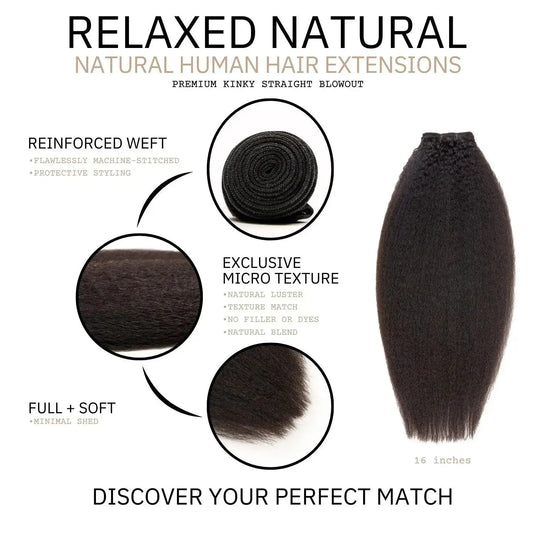
Shop Relaxed Natural
-
RELAXED NATURAL - TRUTIP™ MICRO LOOP HAIR EXTENSIONS (I-TIP)
5.0 / 5.0
(2) 2 total reviews
Regular price From $139.00 USDRegular priceUnit price / per$0.00 USDSale price From $139.00 USD -
RELAXED NATURAL - TAPE IN HAIR EXTENSIONS
5.0 / 5.0
(2) 2 total reviews
Regular price From $133.00 USDRegular priceUnit price / per$0.00 USDSale price From $133.00 USD -
Sold outRELAXED NATURAL - PONYTAIL
5.0 / 5.0
(4) 4 total reviews
Regular price From $184.00 USDRegular priceUnit price / per$0.00 USDSale price From $184.00 USDSold out -
RELAXED NATURAL - NATURAL HAIR EXTENSIONS
4.91 / 5.0
(33) 33 total reviews
Regular price From $125.00 USDRegular priceUnit price / perSale price From $125.00 USD